
Good Vibrations
The Magic of the Orb Weaver Spider

When I was a kid, I’d play with my friends in our little clubhouse in the backyard, which was a dirt crawlspace behind the shed and the fence that bordered our neighbors. All sorts of creepy-crawlies were back there. My curiosity won over any sense of disgust, and I’d pick up rolly pollies, pincher bugs (earwigs), and, as it went, the many spiders that roamed around back there. I let them crawl on my hands and arms, dispelling any latent arachnophobia I may have had.
I watched Orb Weavers spin their web and capture so many unlucky flies. The web structure fascinated me. I’d slowly disassemble the web, strand by strand, and watch them rebuild their prey nets. It wasn’t any sort of malicious intent, but rather a drive to understand how these spider webs worked. I don’t think the science was quite there when I was a kid, on understanding how the spiders used their web’s vibrations, but I now do.
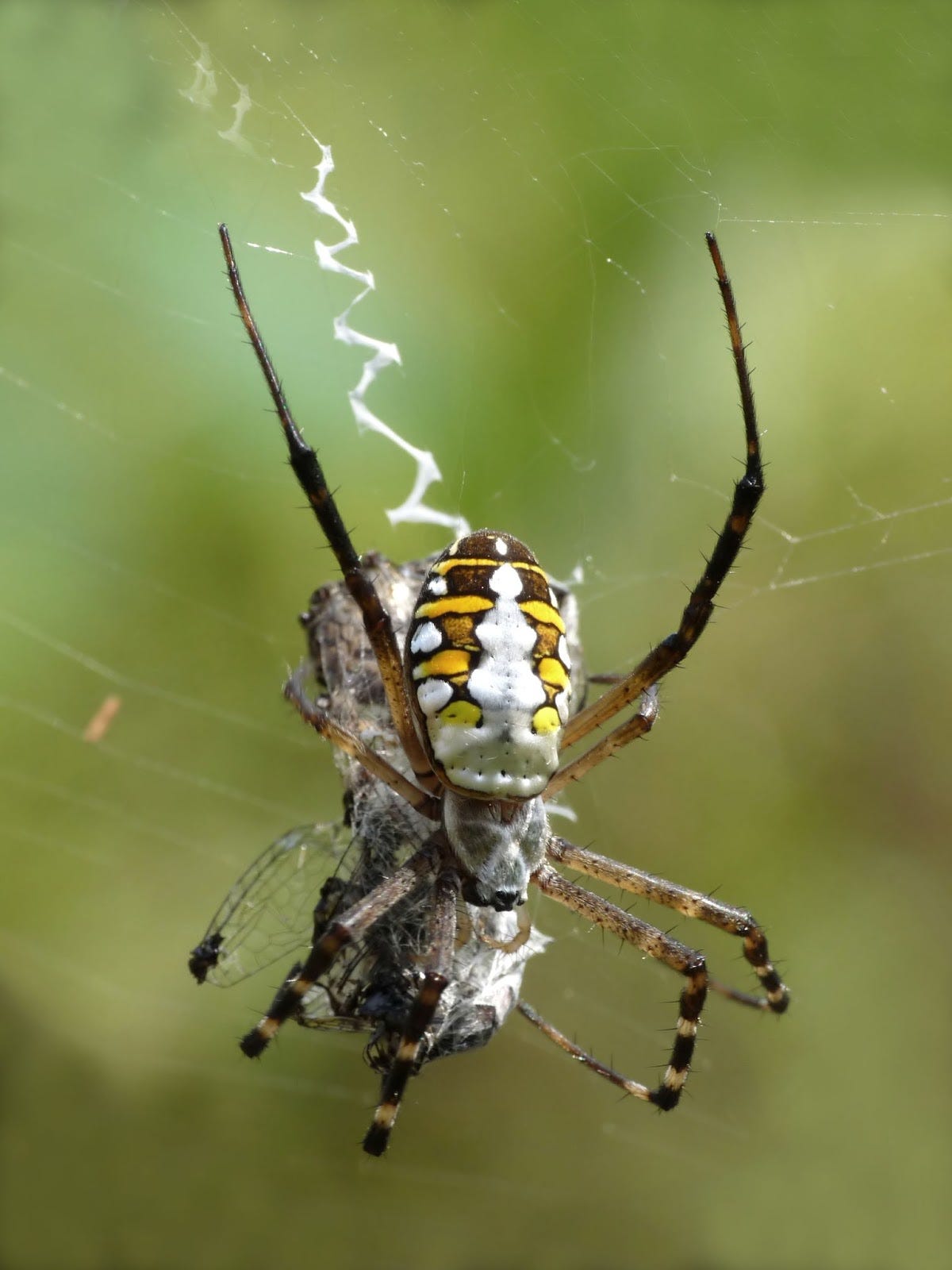
Attribution: © 2011 Jee & Rani Nature Photography (License: CC BY-SA 4.0)

A few years ago, while reading Ed Yong’s “Immense World”, the book that changed everything for me, I found some answers. And since then, I’ve conducted further research on the topic.
The Sightless Plight of the Orb Weaver
It turns out that the eyesight of Orb Weavers is pretty much nil. Since they can only see shadows and motion, but not any detail, they use their web itself as a sort of external sensory organ, with the vibration of the threads acting as input to both Slit sensilla and Trichobothria.
The slit sensilla are isolated microscopic cracks or groups of cracks arranged in parallel arrays called lyriform organs, which are found in the spider’s exoskeleton, and are used to sense substrate vibrations. Trichobothria are tiny sensory hairs that pick up air currents and vibrations, so that these spiders can determine if the vibrations are coming from the air around them or from their web, allowing them to sense the movement of prey or changes in the wind, providing advantages for predatory behaviour and survival.
To Catch A Fly
When a fly gets caught in the sticky web, it struggles and creates chaotic vibrations. The spider uses its slit sensilla and trichobothria to recognize it as a fresh catch or to distinguish it from environmental sounds, such as wind, or movements in its support structure (trees, fences, etc.). Not only can it distinguish environmental vs prey cues, but the spider can even distinguish between a small gnat (characterized by high frequency and light amplitude) and a larger insect (characterized by lower frequency and stronger amplitude). If the victim is too small, it may not be worth eating, and if it’s too large, it could present a problem for the spider, so that’s also valuable information worth knowing.
The Spider Centers Itself
As you may have noticed, these spiders sit at the center of their web and place their legs on separate radial lines, each one acting like a separate vibrational input channel. When a flying insect gets stuck, its vibrations reach some legs sooner than others, and with greater or lesser strength. The timing and amplitude of the vibration allow the spider to rapidly triangulate the location of its prey: stronger vibrations mean they are closer to the center, and weaker ones mean it is further away.
The spider will then assess what to do, and if it is going to eat the prey, it knows exactly what it might be and where to go to get its meal.
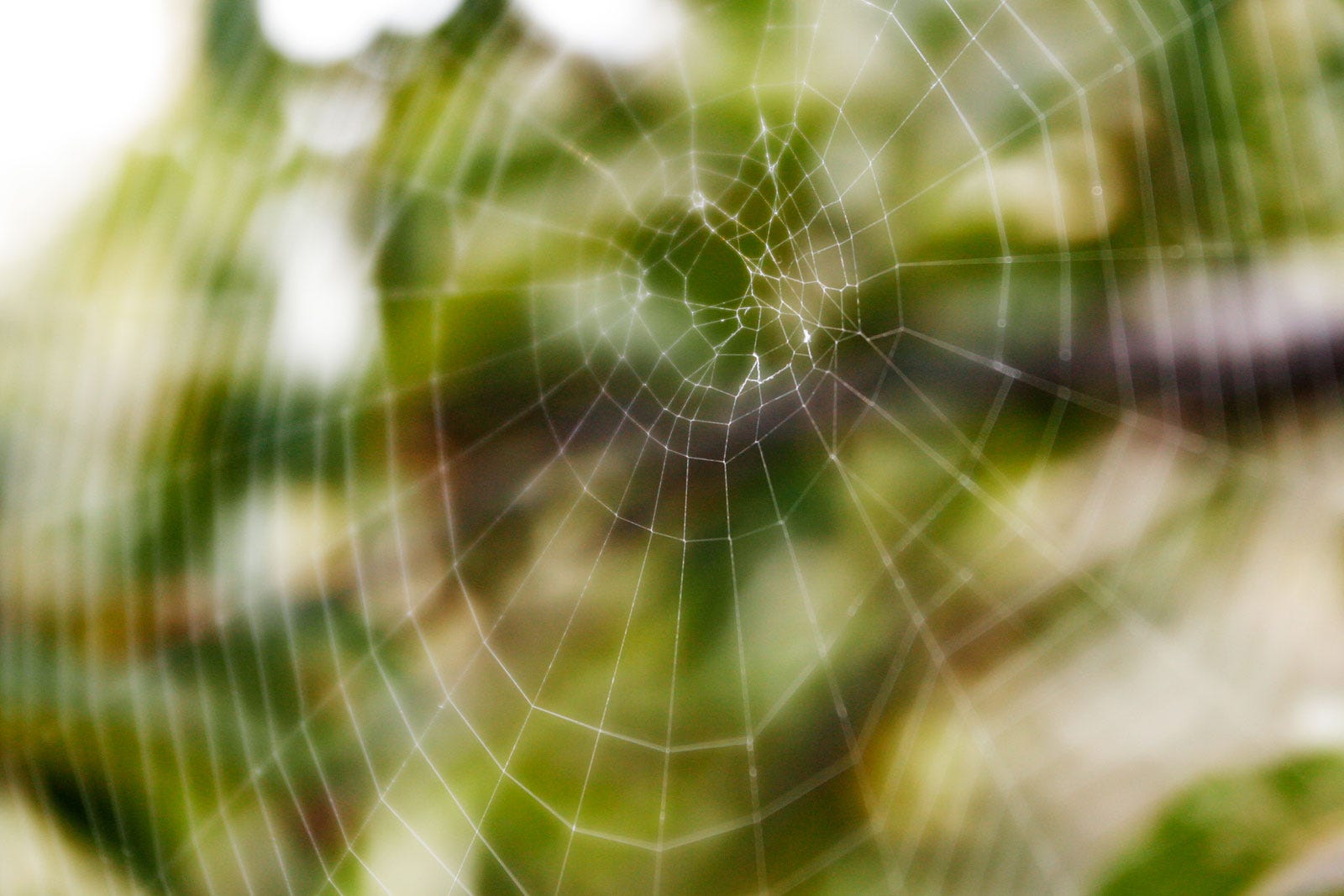
“Orb Weaver Spider’s Web” by Fir0002 / Flagstaffotos, licensed under CC BY-NC 3.0
The Magical Web: A Finely Tuned Musical Instrument Used For Extended Cognitive Learning
The web of a spider is like an instrument, and like any good instrument, it needs to be properly tuned. Orb weavers adjust the tension of their silk lines, not with tuning pegs, but rather by cutting and reattaching lines. Tight threads act like guitar strings, carrying specific vibrations quickly and clearly, while looser threads dampen vibrations, filtering out wind noise and even biasing the web toward certain prey sizes according to the spider’s preference.
They pluck their own web to determine its condition and adjust their web under windy circumstances to filter out excess environmental noise, allowing them to continue honing in on their prey.
The web itself is like a cybernetic extension of the spider, with systems of control and feedback, not entirely unlike our own cognitive abilities, which utilize a centralized nervous system. Spiders like Orb Weavers are not cognitively limited but rather show a wide diversity of learning behaviors from habituation to contextual learning. They can rapidly adjust their behavior in response to environmental inputs, possessing a form of adaptive intelligence tied to their unique vibrational sensory mechanism, which can detect distance, size of prey, number of prey, and other valuable information in the web of life.
Guitar Solos For Love and Life
The web is also used for courtship. The much smaller male orb weavers “strum” specific patterns on the female’s web to avoid being mistaken for prey and eaten (though sometimes the females deliberately eat them anyhow…oops!). The female can tell it’s not a random prey struggling because the rhythm is unique. Each species has its own pattern. And, in some cases, males will strum unique patterns to distinguish themselves from one another, kind of like who can play the best guitar solo in hopes of mating and not ending up becoming a meal.
Spider Hackers
Finally, like anything on the World Wide Web, there are also spider hackers. Some spiders, such as kleptoparasites like Argyrodes, deliberately pluck threads in short, irregular bursts that mimic a struggling insect, tricking the host into rushing over. Then, they use stealth and quick raids to steal its captured prey, some silk, and, in some cases, they will even ambush the Orb Weaver itself.
Final Thoughts
From the childhood curiosity of poking around a backyard shed filled with bugs, and watching spiders spin to modern science revealing the complexity of sound vibrations, the humble Orb Weaver reminds us that the world is filled with subtle signals as long as we know how to tune into them. Their webs are not just traps but finely tuned instruments used for survival, communication, and even love. This shows us that life can be played like music, intricately, risky, and astonishingly precise. Good vibrations, indeed.
What a beautiful instrument this is.
The Immense World book literally had an immense impact on me! The best part of that book was seeing a spider web as a musical instrument. 👍👍🎶