
Hijacking a Cockroach

The other day, I was at my new co-working space, Frontier Tower, and I saw the RoboRoach control kit by Backyard Brains on the table in my new home in the bio lab. It allows you to electronically control a cockroach. It’s even app-controlled through Bluetooth. This technology has been around for a while, as seen by their published date on YouTube and from this IEEE Paper, which discussed electronic impulses.
When Biohackery Tests Our Boundaries
It’s biohackery at its best and worst, and reminds me of an old Ars Electronica piece by Garnet Hertz, which uses a roach to control a robot. My own ethics of biology are usually that we should let nature do its thing and not interfere, which we as humans so often do. But roaches disgust me, and somehow making them into something you can control seems intriguing. I know this isn’t morally consistent, but there you have it.
Roach Biobots
To make a RoboRoach or roach biobot, a cockroach is fitted with a low-power electronic backpack and electrodes. Then, the antennae and cerci are selectively stimulated to trigger an escape response. For instance, if you stimulate the right antenna, the biobot turns left as a part of an avoidance reflex, and vice versa. This allows you to control where the cockroach goes, much like you would an electronic robot.
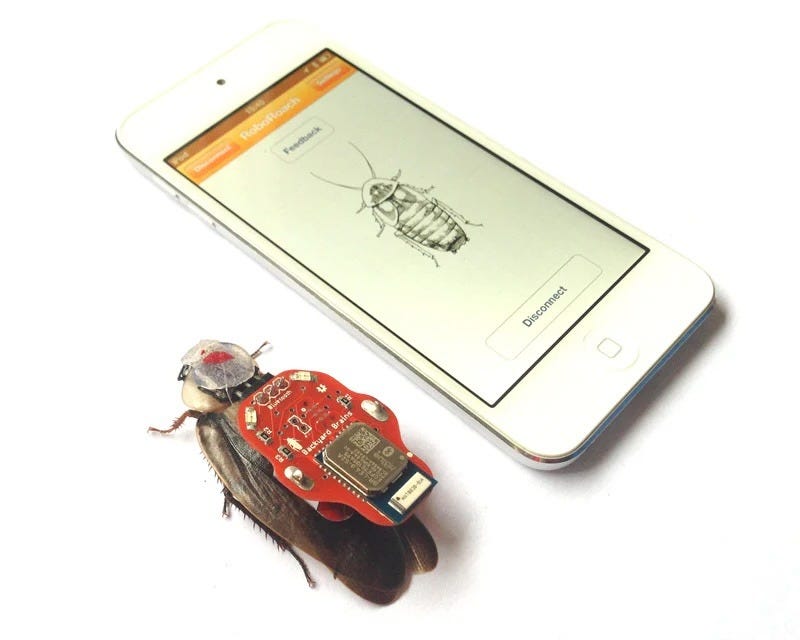
RoboRoach by Backyard Brains
Roaches to the Rescue?
While some people may be creating these biobots out of curiosity or entertainment, researchers are working on practical applications as well. They are trying to develop reliable roach biobots for search-and-rescue operations in collapsed buildings. They would release a team of biobots into the rubble, which would then travel through the debris. Their electronic sensors would send data back to a central location, where it would be analyzed to look for survivors. One day, cockroaches may do more than disgust us; they may actually come to our rescue.
The Emerald Cockroach Wasp: A Different Form of Biohackery
I remembered reading about how a certain species of wasp also hijacks a cockroach, but they do it not electronically, but rather through a whole other form of hackery. The emerald cockroach wasp is tiny compared to its prey, the much-larger cockroach, but it has a weapon at its disposal, which is chemical rather than electronic.
The details are complex, but it’s kind of like getting anesthetized before surgery, where you get an injection that will calm you down, and then you get the real dose of what knocks you out entirely.
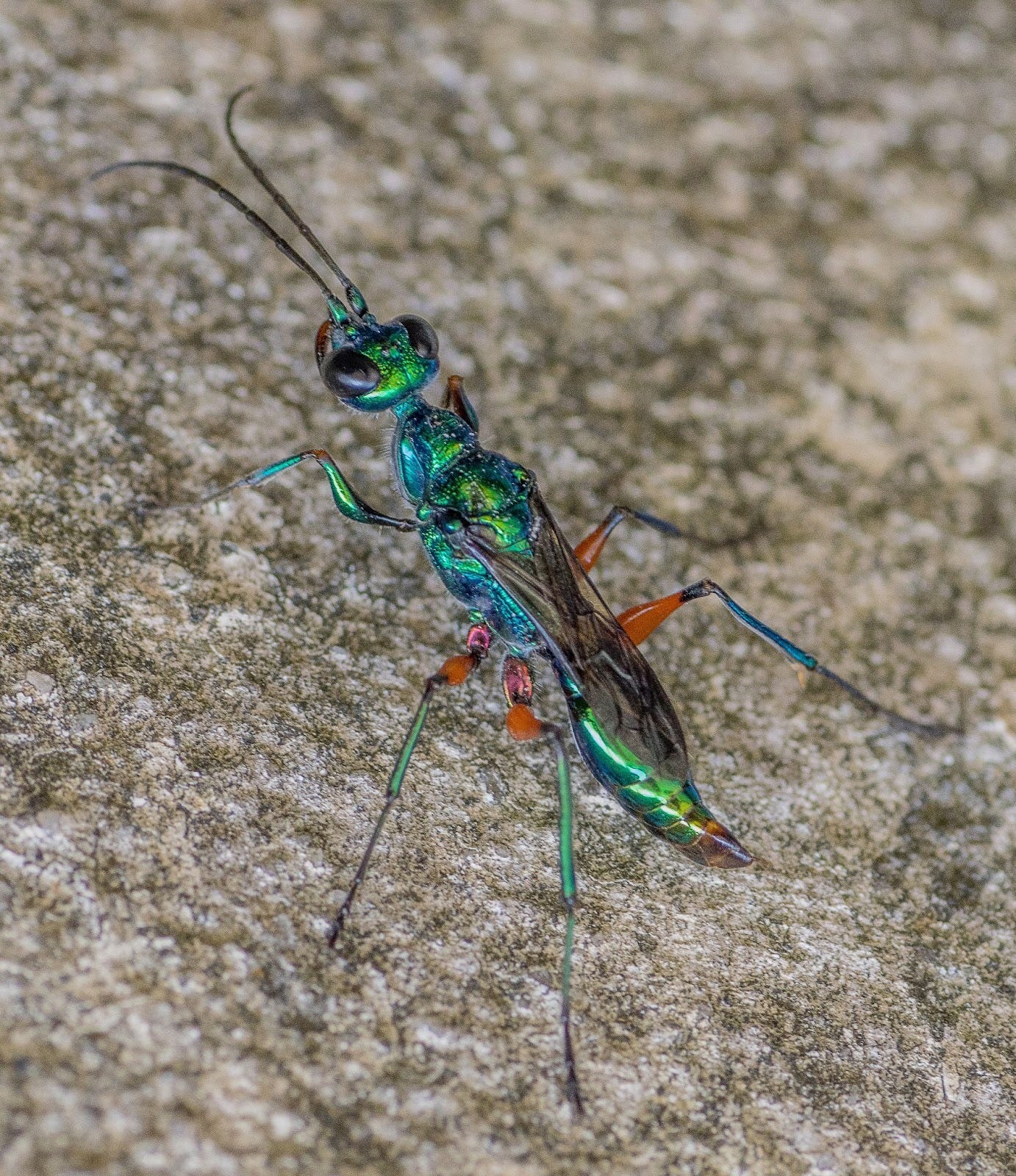
“Jewel wasp (Ampulex compressa)” by Zezinho68, licensed under CC BY-SA 4.0 (https://creativecommons.org/licenses/by-sa/4.0) via Wikimedia Commons. commons.wikimedia.org

The Making of a Zombie Roach
The female wasp first stings the cockroach’s thoracic ganglion, a cluster of nerve cells in the thorax, with a mild, paralyzing biochemical agent. This causes the cockroach to lose control of its front legs. While the cockroach is incapacitated, the wasp delivers its second blow. This time, the wasp takes its time to find a precise spot in the ganglion in its head (essentially its brain) in the section that controls its escape reflex. The wasp injects a second dose of a different venom, and at this point, the cockroach starts grooming itself excessively for about 30 minutes. Then it becomes slow and fails to show any normal escape or survival responses, behaving almost zombie-like.
Next, the wasp chews off half of each of the roach’s antennae and feeds on the hemolymph (roach blood) that leaks out of them. Now that the unlucky roach has been subdued, the wasp leads the cockroach with its own antennae as a guiding stick, not unlike a dog on a leash. That’s some dark animal behavior at work. It’s an ingenious adaptation, and I don’t know how this happened.
The wasp then leads the zombie-roach to its burrow, where it lays 1-2 eggs between the roach’s legs. The wasp leaves and seals off the burrow to keep predators out. The roach is now food for the wasp’s offspring, which was the ultimate goal of this zombification. The cockroach’s metabolism has been slowed down by the wasp’s chemicals, so it hardly moves. The eggs hatch 3 days later to find a tasty meal just sitting there obediently waiting to be eaten. The larvae feed on the cockroach for 4-5 days, then chew their way into the still-living roach’s abdomen. There, the larvae live for 8 more days, consuming the internal organs and finally killing their host before creating a cocoon inside the roach’s corpse. Shortly after, they emerge as adult emerald cockroach wasps, ready to create their own zombie roaches.
A Synchronized Sea of Robotic Roaches
I’m tempted to order a RoboRoach kit, or even figure out the electronics and make my own. I’m not that squeamish, but handling roaches gives me the icks. Still, could I build a bunch of sensors that control these via Wi-Fi, making a synchronized sea of robotic roaches? A sort of live bio-performance.