
Hyphae and Hades
Notes from the Underworld

You probably haven’t heard of Hyphae. They are the building blocks of a third kingdom of life: fungi. Like the Greek god Hades, hyphae rule the underworld, and like Hades, they are often ignored. And just like Hades, they transform the dead into another state entirely, recycling rotten bodies, such as dead trees, into nutrients.
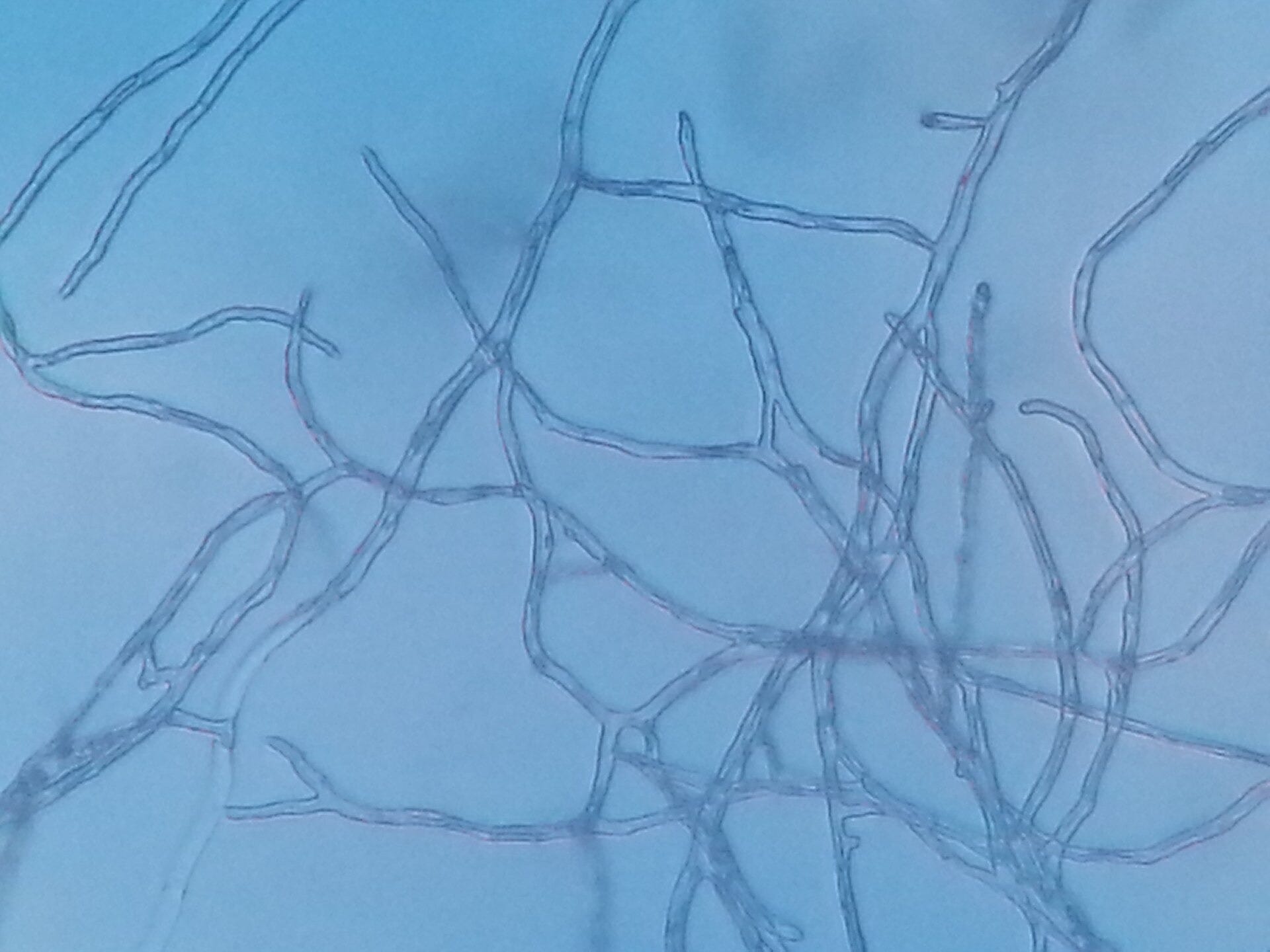
Image: Fungal hyphae and mycelium by Ajay Kumar Chaurasiya, via Wikimedia Commons, CC BY-SA 4.0
From Invisible Threads to Mighty Mushrooms
Hyphae (pronounced “high” + “fee”) are microscopic thread-like tubes that connect over huge distances, not uncommonly up to ¼ of a mile. When they bundle together and interconnect, they form mycelium, which is simply a network of these bunched-up microscopic threads, often but not always visible to humans. These mycelium, when the conditions are correct with the right amount of rainfall, shade, and nutrients, produce mushrooms. Mushrooms are the fruiting bodies, which release spores, which in turn generate more hyphae.
The Limits of Human-Centered Intelligence
I am in the middle of reading Entangled Life by Merlin Sheldrake, and my head is buzzing with excitement. Why did I not know about hyphae? Cognitive science, with its emphasis on human intelligence, is one answer. Another is that digging them up and studying them becomes very difficult, so research is limited.
Hyphae extend throughout topsoil. The depth is usually about 0-30 cm (0-12 inches), so they are just underneath our feet. They grow seemingly magically, forming long microscopic filament chains. And they have, dare I say the word, intelligence.
Rather than defining intelligence as a centralized brain, I prefer thinking of it as the capacity of a system to perceive information, process it, learn from it, and use it to adapt behavior toward a goal. This definition gets us unstuck from anthropomorphic lens, and it becomes a lot easier to accept that these are intelligent creatures.
The Hidden Intelligence Beneath Our Feet
Hyphae are highly adaptable. They spread slowly, and when they encounter, say a tasty dead tree branch, they signal throughout their network to move towards it. Think of a 3D mesh network, with nodes and interconnected points, that slowly move towards the nutrients. There is no brain, and like octopuses which have their own distributed nervous system, these networks of hyphae are without central authority, true anarchic behavior at work.
Decision-Making Without a Brain
Researchers studying pattern recognition in the mycelium of Phanerochaete velutina arranged colonized wood blocks (food) in soil trays in a cross or a circle pattern and found that the mycelium did not move randomly. Initially, the mycelium grew out radially in all directions, forming evenly distributed connections in the circle-patterned wood blocks. However, in the cross pattern, the central portion was not the most connected or decayed. Instead, the outer blocks were the most connected, serving as outposts for gathering nutrients, while the inner blocks served as transport pathways. While the circle pattern showed the most decay at the end, the cross pattern showed something more important: the fungus adapted its network to optimize how it gathered and distributed resources based on the spatial arrangement of its environment. And when the hyphae were damaged, it abandoned the inefficient pathway, reinforced productive ones, and learned to avoid previously disrupted areas.
The fungus has no brain, yet it clearly makes decisions about where to direct the hyphae. Its intelligence emerges from that network of hyphae, allowing it to interpret its environment and solve spatial problems. Anarchy becomes order.
The Success of Anarchy: How Fungi Create Language From Apparent Disorder
Anarchy has proven to be successful. How do fungi do this? Signaling happens through electricity. When I was researching some of my own work with making mycelium-generated music, I discovered that researchers such as Andrew Adamatzky have shown that some species of mycelium have over 50 different electrical phonemes, which they demonstrated can be interpreted as a fungal language. They recorded signals, oscillations of extracellular potential, that often occurred in clustered trains similar to neuronal activity. They translated the pulses into mathematical words and sentences, finding that they closely matched human languages. They also found that the signals are very species-specific.
In similar work, researchers inserted microelectrodes into mycelium and fruiting bodies of the wood-decay fungus Pleurotus ostreatus. When scientists introduce new nutrient sources, remove wood blocks, or physically damage the hyphae, they observe changes in the electrical activity of the network: spike frequency often increases when new nutrients appear, electrical pulses propagate along the mycelial cords connecting resources, and injury can trigger bursts of signaling activity. This suggests that it’s the fungal electrical signaling that may play a role in coordinating growth direction, nutrient redistribution, and damage response across the network, though the exact mechanism remains unclear
The Pulse of the Mycelial Network
Much work needs to be done on this. We don’t know exactly why these signals exist, but the experiments have shown that mycelium produces electrical spikes that change in response to changing environmental stimuli. Not only does the signal change with different stimuli, but the direction and growth of the hyphae also change in response to those signals. Is this not like our own intelligent bodies sensing environmental stimuli? When we sense a hot element on the stove, we automatically pull our hands away in response. Is that any different from the mycelium’s damage response? Since most of us agree that humans are intelligent, does this mean that the true lords of the underworld, the hyphae, might be intelligent too?
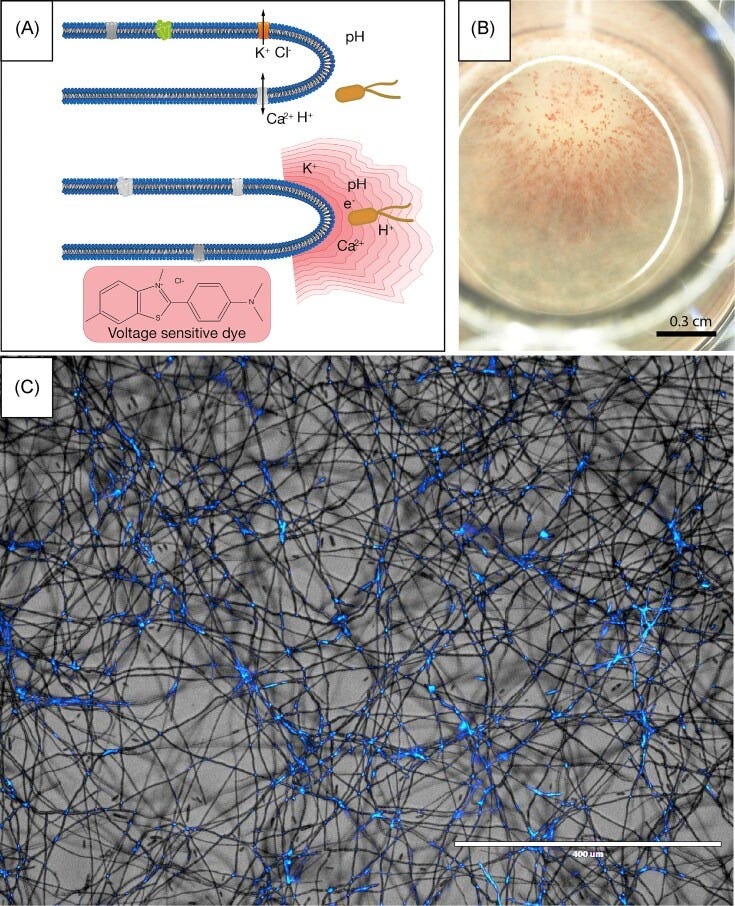
Fig. 6 from Electrical signaling in fungi: past and present challenges by Buffi et al., via PubMed Central, CC BY-NC-ND 4.0
The Story of the Intelligent Underworld Continues
Mind blown. For those of us who have centralized brains to be blown, that is. There is so much more to this story. I haven’t even gotten into the mycorrhizal network, and the popular discoveries of the “Wood Wide Web,” which is how fungi and plants interconnect and work together to share nutrients and resources, even between species and kingdoms. I’m still only partway through Entangled Life, and already I’m waking up in the morning excited to read what’s next.
So so fascinating!