
Spidey-sensing Crickets
Hyper-evolved defense mechanisms

Once again, after reading Ed Yong’s Immense World, I was inspired. This time, it was the classic predator-prey relationship, a sort of arms race of sensory evolution. I began thinking about a specific relationship between the wolf spider and the wood cricket, and it stuck with me. The super-sensing of the wood cricket is utterly remarkable.
The wolf spider, which is similar to the jumping spider in terms of relying on eyesight, hunts its prey, including crickets, by sneaking up on them and chasing them down. They are bigger, stronger, and faster, and so they will often win their fights.
The Power of Cerci
However, the crickets possess a few evasive mechanisms of their own in this arms race of sensory evolution. The most compelling one is their cerci, a pair of spines that sense air vibrations.
Not just by a little bit, but a lot. I mean, they sense everything.
The cerci are small sensory organs that are covered with hundreds of tiny filiform hairs, which can detect even the most minor molecular vibrations caused by the slightest amount of disturbance in the air, on the level of anything that comes close to it.
Despite knowing about the cerci for so long, researchers are still studying how predators affect the survival and behaviour of the wood cricket (Nemobius sylvestris) by exposing different cricket life stages to three conditions: aerial predators only (“air”), wolf spiders only (“spider”), and no predators (“control”). Early-stage juveniles showed the highest predation, particularly from wolf spiders, which are abundant in their natural habitats. Those juveniles hid more frequently, staying off leaf surfaces to avoid detection; a response not observed in the air-only or control treatments. Young wood crickets don’t just hide at random; they read the danger level in real-time using their cerci, and they change their behavior to stay alive.
When the spider gets close, the cricket jumps in some direction, well out of the way of the spider. It works almost all of the time. In short, you can’t sneak up on this cricket.
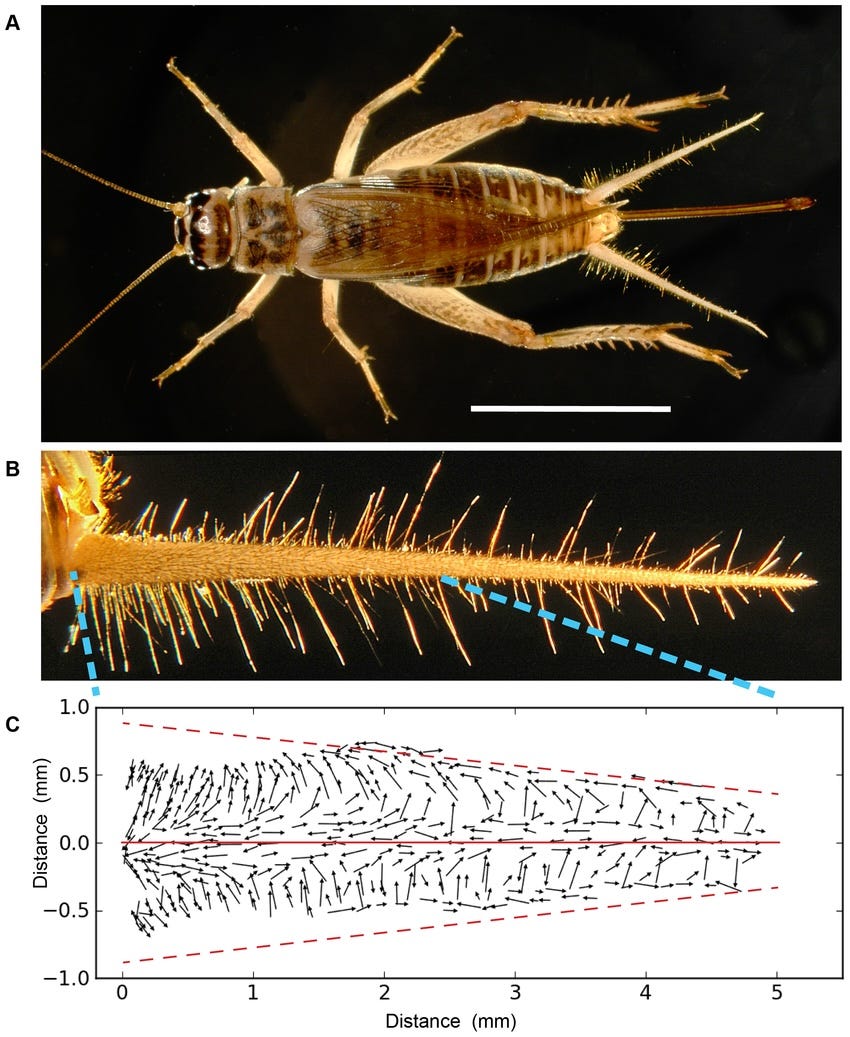
Filiform mechanosensory hairs on the cerci of Acheta domesticus.
Heys, J. J., Rajaraman, P. K., Gedeon, T., & Miller, J. P. (2012). A Model of Filiform Hair Distribution on the Cricket Cercus. PLoS ONE, 7(10), e46588. https://doi.org/10.1371/journal.pone.0046588
Nano-Sensing-Maximalization
What stuck with me was the nano-sensing of the cricket. It’s a special built-in superpower. Along the tips of their cerci, crickets have rows of microscopic filiform hairs that act like ultra-sensitive motion detectors. Each hair is tuned to respond to the slightest air movements down to the size of molecules, so a cricket can “feel” a predator’s approach before it even touches the ground or rustles a leaf.
As Yong points out, this is the rare case of maximalization, where the sensors, the cerci, can’t possibly be any more sensitive than they are without being overwhelmed by molecular noise from the air itself. In other words, crickets have reached an evolutionary endpoint with these structures, a perfect balance between performance and practicality that we simply cannot improve upon.
This maximal sensitivity comes with profound survival benefits. A cricket doesn’t need to see a spider stalking it nearby; it simply senses the faint shift of air as the predator moves and responds with an immediate, life-saving jump. It’s a reminder that natural selection doesn’t just shape strength or speed; sometimes it hones perception to near-perfection, allowing a small, seemingly fragile creature to persist in a world full of threats.
Custom Electronics to Help Sense the World as a Cricket Would
My own work in creating custom electronics sensing boards often stems from what is already available. Although I haven’t (yet) put it to practical use, I created a “wind sensor” board that detects very small disturbances in the wind above it. It’s a lot like how a cricket would sense the world, only on a human scale.
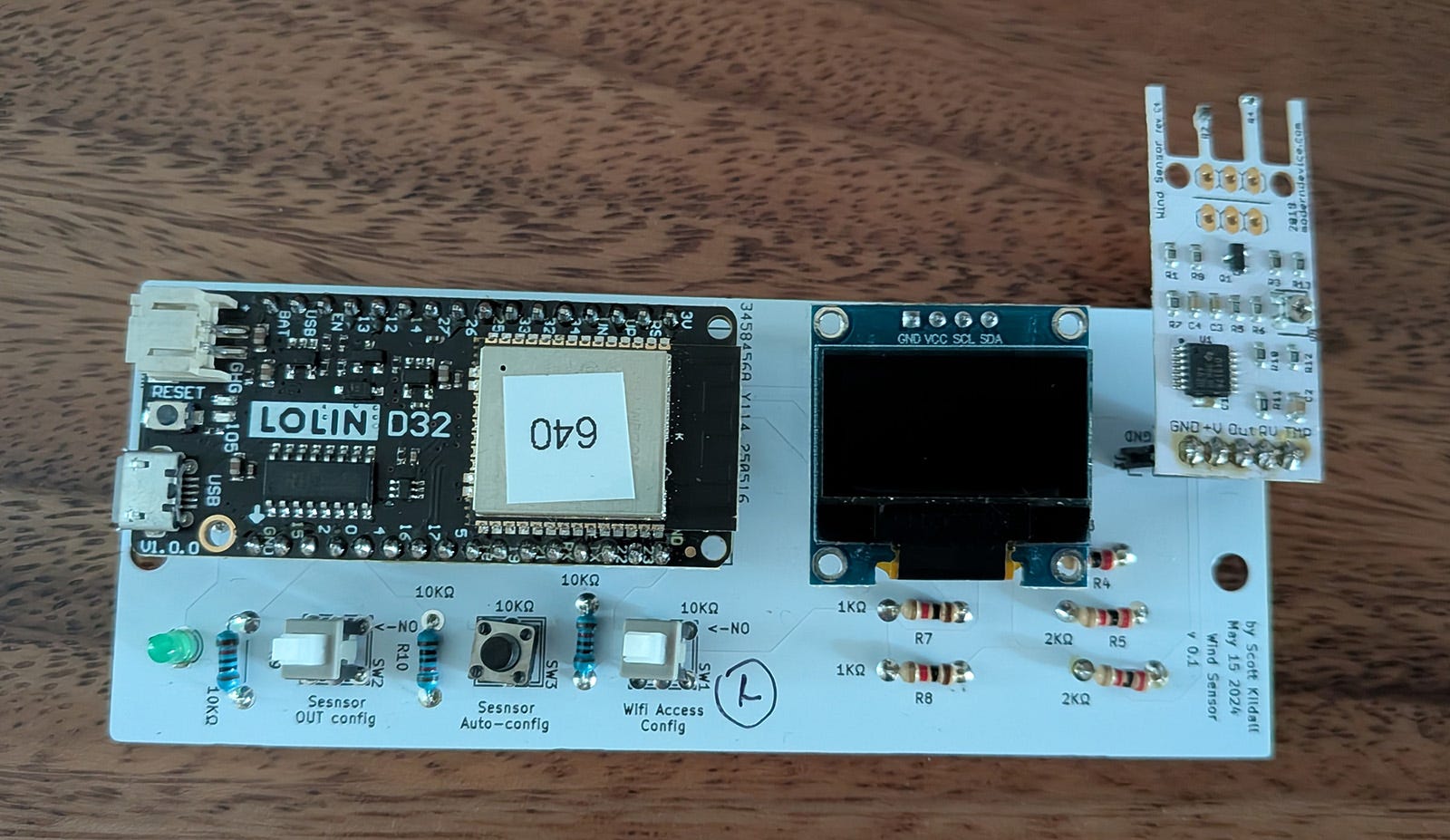
You wave your hand above the sensor, and it captures just the smallest movement. It’s like an anemometer, only a solid-state sensor, with some sort of exponential sensing curve so that it can pick up both small movements and larger changes, but I’m generally focused on the smaller ones.
While I’m not sure when I will make a BioSymphonic installation from this, I am pretty sure that something will arise from it. Maybe many of these in a field, picking up the micro-movements of wind, detecting small changes like so many organisms that we share the world with do on daily basis. These are ones outside of our coarse perception, which we don’t need, but nevertheless offer a fine window into hidden biological realms.
Feeling the World Before It Happens
What fascinates me most about the wood cricket is how it survives not by strength or speed but by tuning into the invisible, pushing its cerci to the very edge of what physics allows. That’s survival through perception; the art of feeling the world so acutely that danger is avoided before it arrives.
When I build my own wind-sensing boards, my sensors may never be as elegant or efficient as the cricket’s, but they let me glimpse what it might be like to live in that hidden layer of information beyond our human senses. Maybe that’s the lesson here: there’s a whole dimension of the world we can’t normally feel, but life all around us uses it every day.